The AI industry is experiencing one of the biggest investment waves in modern technology history. From companies developing advanced AI models to startups building AI-powered applications, billions of dollars are flowing into the sector. Valuations are rising, enterprise adoption is increasing, and new AI companies are emerging across the world.
But there is a question that deserves more attention than another billion-dollar funding announcement: Are AI companies actually growing as businesses, or are investors simply betting on what they might become?
The answer is complicated. Some AI companies are recording extraordinary revenue growth, attracting enterprise customers and expanding internationally. Others are struggling to establish paying customer bases, manage infrastructure expenses or differentiate their products in an increasingly crowded market.
The AI boom is real. However, the financial success of the companies participating in it is far from guaranteed.
The AI Funding Boom Is Real, but Capital Is Becoming Concentrated
Investor interest in artificial intelligence is no longer limited to a handful of technology companies. AI has become one of the most significant investment categories in global venture capital.
According to the OECD, global venture capital investment in AI companies reached approximately $258.7 billion in 2025, accounting for 61% of all global VC investment. Generative AI companies attracted $35.3 billion.
However, the funding market is becoming increasingly concentrated. Mega deals worth more than $100 million accounted for approximately 73% of AI investment value in 2025.
This means that although AI investment is expanding, a significant proportion of the money is flowing towards a relatively small number of companies.
Investors are increasingly looking for proprietary technology, enterprise customers, computing infrastructure and the potential to become dominant platforms. Smaller startups with similar products are finding it harder to attract comparable attention.
OpenAI and Anthropic: Evidence That AI Businesses Can Generate Serious Revenue
Two companies demonstrate how quickly AI can develop into a commercial business.
OpenAI has built multiple revenue streams through ChatGPT subscriptions, enterprise contracts, API services and business integrations.
According to Sources, OpenAI CFO Sarah Friar said the company's annualised revenue surpassed $20 billion in 2025, compared with $6 billion in 2024. Its computing capacity also expanded significantly, from 0.6 gigawatts to 1.9 gigawatts during the same period.
However, its rapid growth has come with substantial infrastructure expenses and operating losses. Revenue growth does not automatically translate into profitability.
Anthropic, the company behind Claude, has also experienced extraordinary commercial expansion.
Its reported revenue increased from $41 million in 2023 to $386 million in 2024 and approximately $4.6 billion in 2025. Its 2026 financial disclosures subsequently showed $33.2 billion in revenue during the first nine months of the year.
These figures demonstrate genuine commercial demand for AI technology, particularly in software development, enterprise automation and business applications.
However, both companies must continue investing heavily in computing resources, research, and infrastructure.
The important distinction is between building a successful AI product and building a sustainably profitable AI business.
India's AI Startup Ecosystem Is Finally Getting Serious
While the United States continues to dominate global AI investment, India is developing its own AI ecosystem.
Indian startups are approaching the opportunity from different directions. Some are building foundational AI models designed for Indian languages and local requirements. Others are developing AI-powered applications that allow businesses and individuals to automate tasks without requiring extensive technical knowledge.
According to The Unicorn Magazine's 2026 AI startup analysis, more than 1,500 AI startups are being tracked in India. The sector attracted approximately $676 million across 57 funding deals in the first half of 2026, compared with $162 million across 30 deals during the same period in 2025.
The increase is significant, particularly when broader Indian startup funding has faced pressure.
However, the Indian AI ecosystem is still developing. The next challenge is converting investment and technological progress into recurring revenue, customer retention and sustainable profitability.
Three companies illustrate the different opportunities emerging in this market.
Sarvam AI: India's Sovereign AI Ambition Reaches Billion-Dollar Territory
Bengaluru-based Sarvam AI, founded in 2023 by Pratyush Kumar and Vivek Raghavan, is among the most important companies in India's emerging AI ecosystem.
Unlike application-focused AI startups, Sarvam is attempting to build a broader AI ecosystem, including foundational models, speech technology, language processing, inference infrastructure and enterprise applications.
Its central ambition is to develop AI technology that works effectively for India's linguistic diversity, businesses and public institutions.
In June 2026, Sarvam announced that it had raised $234 million in the first close of its targeted $300 million Series B funding round at a post-money valuation of $1.5 billion.
HCLTech led the investment with a commitment of approximately $150 million, alongside Bessemer Venture Partners and existing investors Khosla Ventures and Peak XV Partners.
The funding is significant for two reasons.
First, it demonstrates that Indian technology companies and global investors are increasingly interested in developing domestic AI capabilities.
Second, it highlights the growing importance of sovereign AI infrastructure, particularly for sectors where data security, language capabilities and local deployment matter.
Sarvam has also reported substantial usage across its products. According to its June 2026 company announcement, its conversational platform was handling more than two million interactions daily, while its inference platform processed over 10 million API calls daily.
The company also reported that its vision technology was being used to digitise more than 35 million pages of documents.
These are meaningful indicators of product adoption. However, usage numbers and funding valuations should not be confused with audited revenue or profitability.
Sarvam's biggest challenge will be turning its technology and institutional partnerships into a commercially sustainable business that can compete with global AI providers.
Emergent: An Indian AI Startup That Reached $100 Million ARR in 8 Months
If Sarvam represents India's ambition to build foundational AI technology, Emergent represents a different opportunity: making software development accessible to people who cannot code.
Founded by Mukund Jha and Madhav Jha, Emergent operates in the rapidly growing AI-assisted software development category, often described as vibe coding.
Its platform allows users to describe an application in natural language and use AI agents to design, build, test and deploy software.
This approach is particularly attractive to entrepreneurs, small businesses and non-technical founders who want to build applications without hiring a large engineering team.
In January 2026, Emergent raised $70 million in a funding round jointly led by SoftBank Vision Fund 2 and Khosla Ventures. The funding valued the company at approximately $300 million, according to The Unicorn Magazine.
The company reported having more than five million users and approximately $50 million in annual recurring revenue at the time.
Just one month later, in February 2026, Emergent announced that its ARR had crossed $100 million. It also reported more than six million users across 190 countries and approximately 150,000 paying customers.
This is an extraordinary growth trajectory for a relatively young AI startup.
However, there is an important financial distinction: ARR is the annualised value of recurring subscriptions at a particular point in time. It is not necessarily the same as revenue actually recognised during a full financial year.
Emergent's growth also raises an important question about competition. AI-assisted coding is becoming increasingly competitive, with international players such as Lovable and Replit targeting the same market.
The long-term opportunity will depend on whether Emergent can retain customers, maintain healthy gross margins and develop a stronger enterprise business.
Its growth demonstrates that Indian-founded AI startups do not necessarily need to build foundational models to create large technology businesses.
Krutrim: India's Attempt to Build an AI and Cloud Infrastructure Business
Another important name in the Indian AI ecosystem is Krutrim, founded by Ola's Bhavish Aggarwal in 2023.
Krutrim initially attracted attention with its ambition to develop Indian-language AI models and build a domestic artificial intelligence ecosystem.
The company raised approximately $50 million in its initial funding round at a reported $1 billion valuation in 2024, making it India's first AI unicorn.
Its ambitions extended beyond language models to include AI computing infrastructure and cloud services.
However, building foundational AI technology is an expensive and difficult business. Global competitors have significant advantages in computing capacity, research investment and access to large datasets.
Krutrim's subsequent strategic shift towards AI cloud infrastructure illustrates an important reality: AI businesses may need to change their commercial approach as market conditions and technology requirements evolve.
Its success will ultimately depend on whether it can build competitive infrastructure and attract customers willing to pay for its services.
The Uncomfortable Truth: Revenue Is Growing, but Profitability Remains a Challenge
The biggest misconception surrounding AI startups is that rapid growth automatically means financial success.
Developing and operating AI products requires significant investment in specialised chips, cloud infrastructure, electricity, engineering talent and research.
Unlike conventional software companies, AI businesses can face substantial costs every time customers use their products.
A company may attract millions of users and generate impressive revenue while still spending more money than it earns.
This is particularly important when evaluating companies that are growing through aggressive customer acquisition and subsidised pricing.
Investors should look beyond funding announcements and examine recurring revenue, gross margins, customer retention, infrastructure costs and customer acquisition expenses.
A startup raising $100 million is not automatically more successful than a smaller company generating consistent revenue with a sustainable cost structure.
Why Some AI Startups Will Succeed While Others Will Struggle
The next phase of the AI industry will probably look very different from the current funding-driven expansion.
Companies will increasingly be judged on their ability to solve specific business problems.
Startups offering AI-powered customer support, financial analysis, healthcare automation, cybersecurity and software development could build stronger businesses if their products deliver measurable value.
However, companies offering generic AI tools without meaningful differentiation may struggle as larger technology providers introduce similar features.
For Indian startups, there is an additional opportunity to develop products around local languages, business requirements, enterprise workflows and cost-sensitive markets.
The winners will likely be companies that combine strong technology with distribution, customer relationships and a clear commercial model.
Final Verdict: Is the AI Industry Growing Rapidly or Is It Another Investment Bubble?
The AI industry is genuinely growing rapidly, but the growth story is not equally true for every company.
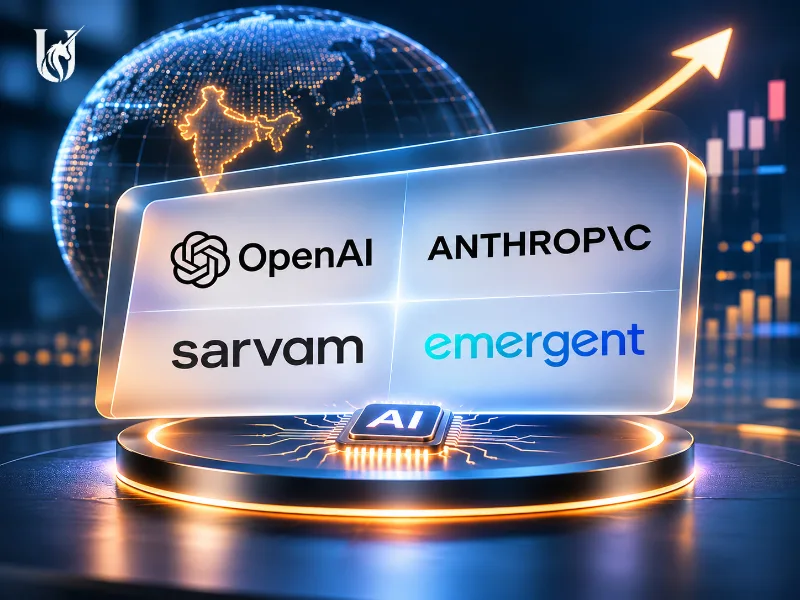
OpenAI and Anthropic demonstrate that AI businesses can generate substantial commercial revenue. Sarvam AI shows that India is attracting serious investment in sovereign AI technology. Emergent demonstrates that AI-powered applications can achieve impressive recurring revenue growth in a relatively short period.
At the same time, infrastructure expenses, operating losses, intense competition and uncertain profitability expose the risks behind the excitement.
India's AI ecosystem has enormous potential, but funding alone will not determine which companies survive.
Some startups will become highly profitable technology businesses. Others may struggle to raise additional capital, lose customers or disappear when competitors offer better products at lower prices.
The industry is not necessarily heading towards a collapse, but neither is every billion-dollar valuation justified by current financial performance.
The next AI winners will not simply be the companies that raise the most money. They will be the companies that turn artificial intelligence into products customers genuinely need, are willing to pay for and continue using.
For founders, investors and the broader startup ecosystem, the real AI race has only just begun. This time, companies will need to prove their business models, not just their technology.
Disclaimer: This article is intended for informational and editorial purposes only. Funding, valuation and revenue figures are based on publicly available reports and company disclosures and may change over time. The views expressed do not constitute financial or investment advice.