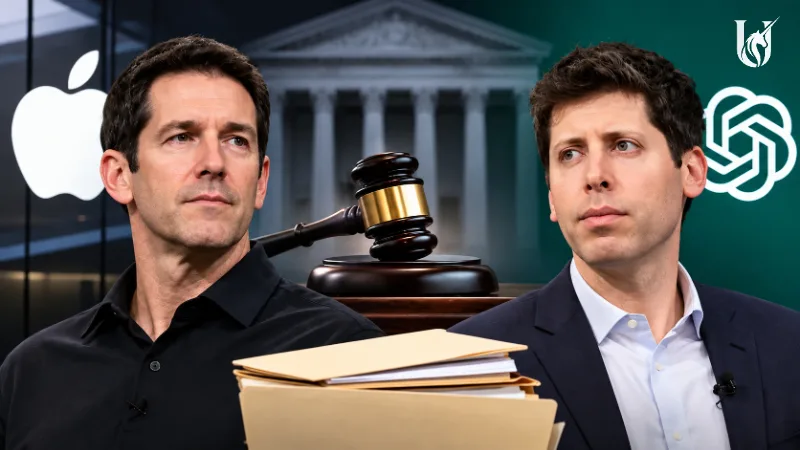
OpenAI has escalated its legal battle with Apple, accusing the iPhone maker of pressuring manufacturing suppliers, restricting access to engineering talent and misappropriating confidential information linked to its planned consumer hardware business.
The counterclaims were filed on November 27, 2026, in the US District Court for the Northern District of California, San Jose Division. They turn a trade-secret dispute initiated by Apple in July into a wider legal contest over supplier relationships, employee mobility and competition in the consumer technology market.
The filing names OpenAI, its hardware business io Products, and former Apple employees Chang Liu and Tang Yew Tan among the parties bringing counterclaims against Apple. OpenAI's claims include allegations that Apple used its influence over suppliers and employment agreements to make it harder for the AI company to develop its own devices.
OpenAI alleges pressure on hardware suppliers
OpenAI claims Apple used its commercial relationships with manufacturing partners to discourage them from working on OpenAI projects. According to the counterclaims, some suppliers feared losing Apple business if they committed staff, production capacity or management resources to OpenAI.
One allegation concerns a specialist finishing supplier that reportedly shifted manufacturing work for OpenAI products to an overnight schedule to avoid overlapping with its Apple-related operations. OpenAI says the arrangement increased its production costs.
The company also alleges that Apple sought information about OpenAI projects, including the names, locations and responsibilities of workers with previous Apple experience. OpenAI argues that this created pressure on suppliers to limit the involvement of engineers who had moved from Apple to the AI company.
These allegations have not been established in court, and the suppliers involved have not been publicly identified in the reporting reviewed.
Dispute extends to employee contracts and trade secrets
OpenAI is also challenging Apple's employment restrictions. Its counterclaims take issue with provisions in Apple's intellectual property agreements that restrict former employees from soliciting or recruiting Apple staff for one year.
OpenAI argues that Apple's definition of confidential information is too broad and could restrict former employees from using professional knowledge and experience gained during their careers.
The countersuit also alleges that Apple obtained confidential information about an unreleased OpenAI device through a former employee who left OpenAI and later returned to Apple. OpenAI says more than 100 confidential files, including hardware images, engineering information and supplier-related material, were sent to personal accounts.
Apple has denied the allegation, saying its investigation found no evidence to substantiate OpenAI's claims. The company has also rejected the broader counterclaims, describing them as an attempt to distract from its original lawsuit.
Why Apple sued OpenAI in the first place
Apple filed its original lawsuit on July 10, 2026, naming OpenAI, io Products, Chang Liu and Tang Yew Tan. It accused former employees of taking confidential hardware information and using it to support OpenAI's consumer-device development.
Apple alleged that Liu accessed confidential engineering files after leaving the company and that Tan, now OpenAI's Chief Hardware Officer, encouraged job candidates to bring Apple components and discuss proprietary technology during recruitment interviews.
OpenAI has denied wrongdoing. In October, following a court hearing at which the judge indicated that an injunction was likely, the company voluntarily agreed not to use trade secrets Apple claims were taken. The agreement also provided for forensic images of devices belonging to employees who might hold Apple's confidential information.
That agreement is an interim safeguard, not a final ruling that OpenAI misappropriated Apple's trade secrets.
A partnership turning into hardware competition
The legal dispute has wider significance because the companies are no longer simply technology partners. In June 2024, Apple and OpenAI announced an agreement to bring ChatGPT into Apple's iPhone, iPad and Mac experiences, including through Siri.
OpenAI, led by co-founder and CEO Sam Altman, has since expanded its ambitions beyond software. Its collaboration with former Apple design chief Jony Ive and the integration of the io Products team have strengthened its push into consumer hardware. Tang Tan, a former Apple executive and co-founder of io, now leads hardware at OpenAI.
Apple, founded by Steve Jobs and Steve Wozniak, has built its hardware business around tightly managed engineering processes and a global supplier network. OpenAI's allegations suggest that access to these manufacturing relationships could become a significant competitive issue as AI companies attempt to develop their own consumer devices.
For the wider technology industry, the case raises questions about where legitimate competition ends and unlawful interference begins. Companies routinely compete for experienced engineers and manufacturing partners, but confidentiality agreements, trade secret protections and supplier contracts can complicate that movement.
Neither side has yet established its allegations in court. The outcome could have implications for how technology companies protect proprietary information while competing for talent and production capacity in an increasingly crowded hardware market.