
Introduction
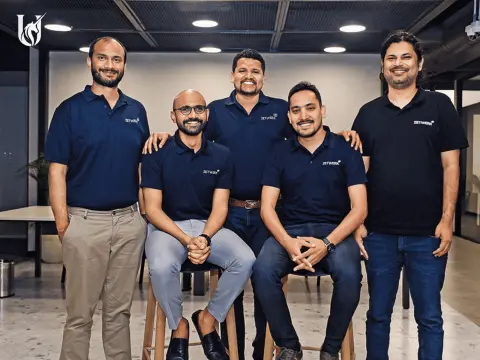
Every generation witnesses a technological shift that changes how the world works. The internet transformed communication, smartphones changed daily life, and artificial intelligence is now redefining how software is created. At the center of this transformation are two Indian-origin twin brothers, Mukund Jha and Madhav Jha, whose startup, Emergent, is challenging one of technology's oldest assumptions: that building software requires years of programming expertise.
Their journey wasn't built on overnight success. It was shaped by academic ambition, entrepreneurial setbacks, world-class research, and the courage to start again. Today, Emergent has become one of Silicon Valley's fastest-growing AI startups, serving millions of users worldwide and achieving a $1.5 Bn valuation after raising $130 Mn in Series C funding. More importantly, the company is making software creation accessible to anyone with an idea, not just professional developers.
Founders' Vision: Making Software Creation as Easy as Conversation
Mukund and Madhav Jha believed that technology shouldn't be limited to those who know how to code. Around the world, millions of entrepreneurs, creators, students, and business owners have brilliant ideas but lack the technical skills to turn those ideas into products.
The brothers envisioned a future where anyone could describe an application in plain English, and artificial intelligence would build it automatically. Instead of spending months writing code, debugging systems, and hiring expensive engineering teams, users could simply explain what they wanted while AI handled the technical complexity.
Their mission wasn't to replace developers, it was to remove the barriers that prevented millions of people from becoming creators.
That simple yet revolutionary vision became the foundation of Emergent.
Company Background: Two Brothers, Two Different Journeys, One Shared Dream
Although Mukund and Madhav are twins, their careers followed remarkably different paths before eventually converging.
Mukund built his engineering foundation in India before continuing his education at Columbia University. Driven by entrepreneurship, he left academia to pursue startups, eventually co-founding Dunzo, one of India's most recognized hyperlocal delivery platforms. While Dunzo experienced rapid growth, it also exposed him to the harsh realities of scaling businesses, capital constraints, operational complexity, and the importance of execution.
Meanwhile, Madhav dedicated himself to research. He completed his PhD in Theoretical Computer Science at Penn State University before joining Sandia National Laboratories as a prestigious John von Neumann Postdoctoral Fellow. His expertise lay in artificial intelligence, algorithms, distributed systems, and advanced machine learning.
For years, the brothers pursued separate careers across different continents. The emergence of generative AI finally created the opportunity to combine Mukund's startup experience with Madhav's deep technical research.
Together, they founded Emergent with one goal, to fundamentally change how software is built.
Challenges: Turning a Bold Idea into Reality
Building an AI company is difficult. Building one that hopes to redefine software development is even harder.
The founders entered an intensely competitive market where global technology giants were investing billions of dollars into artificial intelligence. Every month brought newer language models, stronger competitors, and rapidly changing customer expectations.
Their challenge wasn't simply building another AI assistant. They needed to develop an intelligent system capable of designing, writing, testing, improving, and deploying complete applications with minimal human intervention.
Convincing investors was equally challenging. The vision sounded ambitious: allowing non-programmers to build production-ready applications through natural language alone.
The brothers understood that bold claims would never be enough. Only superior technology could earn trust.
Instead of focusing on marketing, they concentrated relentlessly on engineering excellence.
Growth: Building One of the Fastest Growing AI Platforms
Emergent's growth has been extraordinary.
Within little more than a year of launch, the platform attracted more than five million builders across over 190 countries. Entrepreneurs, startups, educators, designers, freelancers, and enterprises began using the platform to transform ideas into working software within minutes.
The company's AI agents became capable of designing interfaces, generating backend systems, writing production-grade code, testing applications, and deploying them automatically.
Unlike traditional coding assistants that merely help developers write code faster, Emergent introduced an entirely different workflow. Users no longer needed to understand programming syntax, they simply described what they wanted, while AI translated their intentions into complete applications.
This shift positioned Emergent at the forefront of the rapidly growing "AI-native software development" movement.
Expansion: From Research Startup to Global AI Company
As adoption accelerated, Emergent expanded its operations across continents.
The company established a dual presence in San Francisco and Bengaluru, combining Silicon Valley's innovation ecosystem with India's world-class engineering talent.
Its research teams continued improving proprietary AI agents capable of reasoning through increasingly complex software problems, while engineering teams focused on scalability, reliability, and enterprise adoption.
The latest funding is being invested in expanding product capabilities, strengthening infrastructure, accelerating global hiring, and developing the next generation of intelligent software-building agents.
Rather than building a single AI tool, Emergent is creating an ecosystem where software development becomes faster, cheaper, and dramatically more accessible.
Achievements: Building India's Latest AI Unicorn
Emergent's rapid rise has established it among the world's most promising AI startups.
The company achieved impressive annual recurring revenue within months of launch, attracted millions of global users, and earned recognition for developing advanced AI coding agents capable of competing with leading international platforms.
Its biggest milestone came with the successful $130 million Series C funding round, led by prominent global investors, pushing the company's valuation to approximately $1.5 billion and officially giving Emergent unicorn status.
The achievement is significant not only for the founders but also for India's growing AI ecosystem, demonstrating that globally competitive artificial intelligence companies can emerge from Indian-origin entrepreneurs.
Valuation & Net Worth: A Billion-Dollar Bet on the Future of AI
Emergent is now valued at around $1.5 billion, making it one of the newest entrants into the global unicorn club.
The company's latest $130 million Series C investment reflects growing confidence in AI-native software development as one of technology's next major growth categories.
Backed by leading international investors, Emergent is well-positioned to accelerate research, expand internationally, and strengthen its leadership in the rapidly evolving AI application development market.
Its valuation is more than a financial milestone; it represents investor confidence that AI will fundamentally reshape how software is created over the coming decade.
Leadership Philosophy: Innovation Begins Where Failure Ends
Mukund Jha's entrepreneurial journey offers an important lesson rarely discussed in startup success stories.
Before Emergent, he experienced the highs and lows of building Dunzo. That experience taught him that ambition alone cannot build enduring companies. Sustainable growth requires discipline, product-market fit, operational excellence, and constant learning.
Madhav brought a different perspective. Years spent in advanced research taught him patience, scientific rigor, and the importance of solving difficult technical problems instead of chasing short-term trends.
Together, the brothers combined startup execution with research excellence, a combination that has become Emergent's greatest competitive advantage.
Key Lessons from Emergent's Journey
The story of Emergent proves that the biggest innovations often emerge when different experiences come together.
Mukund's entrepreneurial resilience and Madhav's academic brilliance created a partnership capable of solving problems neither could have solved alone.
Their journey also reminds aspiring entrepreneurs that failure isn't the opposite of success, it is often the preparation for it. Mukund's earlier startup struggles gave him the perspective needed to recognize one of the biggest opportunities in artificial intelligence.
Most importantly, Emergent demonstrates that great businesses are built by solving meaningful problems. Instead of asking how AI could replace people, the founders asked how AI could empower millions of people who had previously been excluded from software creation.
That difference in thinking became their biggest competitive advantage.
Conclusion
Emergent is far more than another AI startup. It represents a shift in how technology itself is built.
From two brothers pursuing different careers to building one of Silicon Valley's fastest-growing AI companies, Mukund and Madhav Jha have shown that world-changing businesses are created through persistence, deep expertise, and the courage to rethink established systems.
As artificial intelligence continues transforming industries worldwide, Emergent is positioning itself at the center of that revolution, where ideas become applications, conversations become software, and innovation becomes accessible to everyone.
For every entrepreneur who believes they need years of coding experience to build a product, the Jha brothers have delivered a powerful message: the future belongs not only to those who can write code, but also to those bold enough to imagine what technology should become.
The Unicorn Magazine