From U Education to upGrad
Before the name upGrad became familiar across India's education and startup ecosystem, the venture was being developed under the name U Education. In early 2015, Ronnie Screwvala announced plans for an online education company called U Education, with the aim of disrupting higher education through scale, technology and stronger career outcomes.
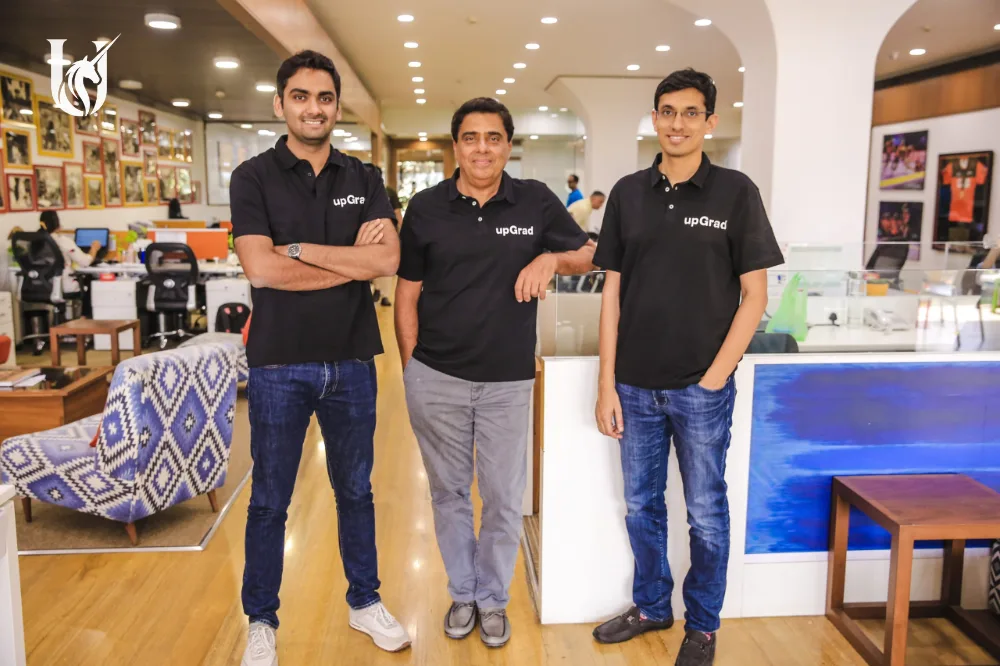
The company was officially launched as upGrad on March 23, 2015. Its founding team included Ronnie Screwvala, Mayank Kumar, Phalgun Kompalli and Ravijot Chugh. While Screwvala brought decades of entrepreneurial and media experience, the other founders brought deep experience in education, consulting, technology, product and operations.
The idea was simple but ambitious: working professionals should not have to leave their jobs or put their careers on hold to learn new skills.
That became the foundation of upGrad's larger promise, “Building Careers of Tomorrow.”
The Problem Mayank Kumar Saw Before upGrad
The idea behind upGrad was strongly shaped by Mayank Kumar's experience in the education sector. Before becoming an entrepreneur, he worked with organisations including Bertelsmann and The Parthenon Group, where he advised on education strategy, investments, market entry and growth.
He saw a market where millions of people wanted better education but traditional higher education was expensive, difficult to access and often disconnected from changing industry needs.
Online learning had already started reducing infrastructure costs and making education more flexible. But there was still a major gap.
There were MOOCs, K-12 platforms and online content providers, but very few platforms were combining formal education, industry skills, mentoring, career support and recognised university credentials into one experience.
That gap became the opportunity.
Ronnie Screwvala Saw More Than an EdTech Business
For Ronnie Screwvala, upGrad was not simply another online-course company.
He had already spent decades building UTV into a major media company and had experienced the changing behaviour of Indian consumers first-hand. He understood that technology could completely change how people consumed content, entertainment and information.
Education was going through a similar shift.
The question was whether people would trust a digital platform with something much more important than entertainment, their careers.
Screwvala believed they would, provided online education could prove that it delivered real career outcomes.
The Four Founders Came From Different Worlds
One of upGrad's strengths was that its founders did not come from identical backgrounds.
Ronnie Screwvala brought entrepreneurial experience, capital and a deep understanding of consumer businesses. Mayank Kumar brought education-sector knowledge and business strategy. Phalgun Kompalli became closely associated with operations and execution, while Ravijot Chugh brought product and technology experience.
Ravijot, an IIT Delhi graduate, had previously worked at Housing.com and The Parthenon Group and had also founded 36hrs.in. His role at upGrad focused heavily on product and the learner experience.
The combination mattered because upGrad was trying to solve several problems at once: education, technology, content, student engagement and employment.
The First Course Was Not a Billion-Dollar Idea
upGrad did not begin with hundreds of courses, thousands of employees or celebrity campaigns.
Its first programme focused on entrepreneurship.
The response gave the founders their first important signal. The programme received around 1,600 applications, with 500 shortlisted, showing that professionals were willing to explore structured online learning when the proposition was credible.
The team started small and spent significant time understanding its learners.
The founders were not simply trying to upload lectures and sell subscriptions. They wanted to build a complete learning experience around the student.
That decision would later become one of upGrad's biggest differentiators.
The Early Challenge: People Did Not Trust Online Education
The biggest obstacle was not technology.
It was trust.
At the time, online education was often seen as a cheaper alternative to traditional education rather than a serious career-building route. Recruiters were not automatically convinced that an online qualification carried the same weight as an offline programme.
Parents questioned whether employers would accept online degrees.
Professionals questioned whether spending money on an online programme would actually change their careers.
upGrad therefore had to sell something much bigger than education, it had to sell confidence in the outcome.
Building the Product From Scratch
The founders understood that technology alone would not solve the credibility problem.
The early team built content specifically around industry requirements and university curricula. The company developed technology to deliver the programmes smoothly while also building mentoring, peer interaction, career services and industry exposure around the learning experience.
upGrad began working with institutions and industry partners to make the programmes more credible and practical.
Its partnerships eventually included institutions such as IIIT Bangalore, BITS Pilani and Cambridge Judge Business School, among others.
The goal was clear: an upGrad learner should not feel like someone watching videos on the internet.
They should feel like they were part of a serious academic and professional ecosystem.
The Business Model Was Built Around Career Outcomes
upGrad developed primarily as a B2C education business, where learners enrolled in programmes and paid fees for their education.
It also built an enterprise business where companies paid upGrad to train employees and support workforce development.
But the company wanted its pricing model to communicate something stronger than affordability.
Some programmes used outcome-linked payment structures, where part of the fee was linked to placement or career outcomes.
The message was powerful: upGrad was not selling a certificate; it was selling a possible change in someone's career.
The Longest and Most Important Phase Was Bootstrapping
One of the most interesting parts of upGrad's early story is that the company did not immediately depend on venture capital.
For almost six years after its 2015 launch, upGrad was 100% owned, funded and run by its co-founders. The company raised its first external funding only in 2021.
That meant the founders had to prove the business before institutional investors entered the picture.
There was no early flood of venture capital to cover every experiment.
The company had to build customers, programmes, partnerships and revenue while remaining relatively capital-efficient.
That discipline later became an important part of upGrad's identity.
2021 Changed the Scale of the Company
After years of operating without external funding, upGrad finally opened its doors to institutional capital.
In April 2021, Temasek invested $120 million in the company. At the time, the investment was reported to value upGrad at roughly $575-675 million, depending on the source and valuation basis.
The company said the money would be used to expand internationally, strengthen technology, grow its degree portfolio and pursue acquisitions.
This was a major turning point.
upGrad had spent six years proving that its model could work. Now it had the financial resources to move much faster.
From $120 Million to Unicorn Status
Just months later, the company raised more capital.
In August 2021, upGrad completed a funding round that took its total funding in that year to around $185 million and pushed its valuation to approximately $1.2 billion. Temasek led the financing, with participation from IFC and IIFL.
upGrad had officially entered India's unicorn club.
For Screwvala, it was another unusual milestone.
He had already built and exited a billion-dollar media business through UTV. Now, years later, he was once again building a billion-dollar company, but this time in education.
The Acquisition Strategy: Build the Whole Career Journey
Once the funding arrived, upGrad began using acquisitions to expand beyond its original higher-education model.
In 2021, it earmarked $250 million for mergers and acquisitions and acquired companies such as KnowledgeHut to strengthen its professional skilling business.
The founders wanted to create a platform that could stay with a learner through different stages of life, from college to the first job, from skill-building to management education and eventually senior leadership.
That was the beginning of upGrad's lifelong-learning strategy.
In 2022, upGrad acquired Harappa Education for a reported Rs 300 crore.
Harappa had built a business around professional and leadership skills and reported FY22 revenue of around Rs 75 crore. At that time, upGrad itself had reported consolidated FY21 revenue of Rs 302.26 crore and a net loss of Rs 211 crore.
The EdTech Boom Was Followed by a Reality Check
The pandemic created extraordinary demand for online education.
But when classrooms reopened and consumer behaviour normalised, the entire industry faced a difficult question: how much of the pandemic-era growth was sustainable?
Several large edtech companies struggled under high costs and aggressive expansion.
upGrad also had to become more disciplined.
Instead of chasing growth at any cost, the company began focusing more heavily on enterprise skilling, higher-quality revenue, operational efficiency and profitability.
That shift would eventually show up in its financial numbers.
FY26: The Rs 2,000 Crore Revenue Milestone
The answer began to become visible in FY26.
upGrad reported gross revenue of Rs 2,070 crore, including taxes, up 7% year-on-year. On an Ind-AS basis, total income stood at Rs 1,732 crore.
The company also reported Rs 530 crore of collected revenue that had yet to be recognised, which is expected to be recognised in future periods.
This is an important distinction because gross revenue and accounting income are not the same thing.
Still, crossing the Rs 2,000 crore gross-revenue mark was a significant milestone for a company that began only 11 years earlier.
The New upGrad Is More Than an Online Course Platform
By FY26, upGrad had moved far beyond the company that launched with one entrepreneurship programme.
The company reported more than 100,000 concurrent learners across online skilling, degree, study-abroad and offline skilling programmes.
On the enterprise side, more than 700 companies chose upGrad Enterprise for employee skilling, recruitment and workforce development during FY26.
Its current platform also lists more than 200 courses, 1,400+ hiring partners, 250+ industry experts and 500+ career experts.
The company now describes itself as a lifelong-learning platform rather than simply an edtech company.
The Unacademy Acquisition Changed the Game Again
Then came one of the biggest chapters in upGrad's story.
On September 1, 2026, upGrad completed its acquisition of Unacademy in an all-stock transaction valued at just over $200 million, or about Rs 1,955 crore at the reported transaction value.
The deal is striking because Unacademy had once been valued at approximately $3.44 billion in 2021.
The transaction therefore reflects how dramatically investor expectations changed across Indian consumer edtech after the pandemic boom.
For upGrad, however, the deal was strategic.
It brought test preparation and additional education businesses into its ecosystem while giving Unacademy's shareholders equity in the combined company.
Internshala Brought Education Closer to Employment
The Unacademy deal was not upGrad's only major 2026 move.
Earlier in the year, upGrad acquired a 90% stake in Internshala through a stock transaction. The deal was reported to value Internshala at around Rs 100 crore, although the companies did not disclose the financial terms.
Internshala brought a large early-career network into the ecosystem, with more than 34 million registered users and 450,000 employers according to the acquisition announcement.
That acquisition fits directly into upGrad's original problem statement.
Education becomes more valuable when it leads to opportunity.
Internships and jobs make that connection much more direct.
From Education to the Entire Career Lifecycle
This is where upGrad's strategy becomes easier to understand.
The company is gradually building a journey that can begin with a student preparing for an exam, continue through higher education, move into internships, then into professional upskilling and eventually leadership education.
Unacademy brings test preparation.
Internshala brings internships and early-career opportunities.
upGrad brings higher education and professional learning.
KnowledgeHut and other acquired businesses add specialist skills.
The pieces are beginning to look less like separate acquisitions and more like one large education-to-employment ecosystem.
upGrad's Valuation: What Is the Real Number?
Valuation figures for private companies can change quickly, especially after acquisitions.
upGrad was valued at around $1.2 billion in 2021 after its unicorn funding round. By 2026, reports around the Unacademy transaction placed the combined entity at approximately Rs 18,000 crore, or about $1.9 billion, while other databases and reports use different valuation methodologies.
Because upGrad is privately held, there is no daily public market price that establishes one definitive valuation.
Therefore, the often-quoted $1.73 billion / Rs 16,500 crore figure should be presented as an estimate rather than a confirmed current market value.
The more defensible current reference point is the reported ~$1.9 billion combined valuation around the Unacademy transaction.
Brand Ambassador
One of upGrad's biggest marketing moves was bringing Amitabh Bachchan into its brand campaigns.
The strategy was simple: if people already trust the person, some of that trust can transfer to the new category.
upGrad also expanded its celebrity-led marketing into southern India, with Prabhas associated with campaigns aimed at strengthening the brand's reach in the region.
For a company trying to become a global lifelong-learning platform, building trust beyond Hindi-speaking markets is an important part of the expansion story.
What Makes upGrad Different From the Beginning
The strongest part of upGrad's story is not that it was online.
It is that the founders understood early that online education alone was not enough.
Students wanted teachers, mentors, peer interaction, university recognition, practical projects and career support.
Employers wanted skills they could trust.
Universities wanted technology and reach.
upGrad tried to bring all of these pieces together.
That is why its business gradually moved from “online courses” towards a much wider model covering degrees, professional learning, enterprise training, study abroad, recruitment and career services.
The Company Had to Change Its Growth Formula
Early-stage startups often grow by spending heavily on customer acquisition.
upGrad eventually realised that this could not be the entire long-term strategy.
The company increasingly focused on enterprise partnerships, acquisitions, organic learner ecosystems and stronger operating discipline.
The Internshala acquisition, for example, directly adds access to early-career talent and employers instead of requiring upGrad to build that network entirely from scratch.
Unacademy brings another large learner ecosystem.
The strategy is becoming less about buying every customer one by one and more about building a connected network where learners can move naturally between education, skills and jobs.
The Biggest Challenge Is Still Trust
Even after a decade, the fundamental challenge has not disappeared.
Education is different from most consumer products because customers are not simply buying something they can return.
They are investing time, money and often years of their lives.
That makes outcomes extremely important.
A learner wants to know whether the course will improve their career. A parent wants to know whether the qualification will be respected. An employer wants to know whether the candidate can actually perform.
upGrad's entire model has therefore been built around answering one question:
What happens to the learner after the course ends?
From “Online Education” to “Lifelong Learning”
When upGrad began in 2015, the company was mainly trying to prove that online higher education could work.
Today, the ambition is much larger.
The company describes its vision as “Powering career success for every member of the global workforce as their trusted lifelong learning partner.”
That single sentence explains the acquisitions, enterprise business, degree programmes, study abroad, internships and test preparation.
The company does not want to sell someone one course.
It wants to stay relevant throughout that person's working life.
The Financial Story Is Still Being Written
upGrad's financial journey has not been a straight success graph.
It moved from founder-funded beginnings to unicorn status, then into aggressive expansion and large losses, before beginning a multi-year turnaround.
The company went from a peak net loss of around Rs 1,142 crore in FY23 to Rs 130 crore in FY26, while EBITDA increased to Rs 123 crore.
That is not yet the story of a company that has completely finished its financial transformation.
It is the story of a company that has begun proving it can grow while becoming more disciplined.
For investors and entrepreneurs, that may be more meaningful than a temporary valuation spike.
The Real Founder Story Behind upGrad
Ronnie Screwvala had already built a billion-dollar media company before he entered education.
Mayank Kumar had spent years understanding the education market and seeing where traditional systems were failing.
Phalgun Kompalli and Ravijot Chugh brought operational and product capabilities to turn the idea into a real platform.
Together, they were not trying to make online education look like a digital classroom.
They were trying to redesign the connection between learning, skills and careers.
What Entrepreneurs Can Learn From upGrad
Start with a real problem. upGrad began with a clear gap between education and the changing needs of working professionals.
Build trust before chasing scale. The company spent years proving its model before raising external capital.
Do not confuse growth with success. The FY23 losses showed the cost of expanding too aggressively.
Be willing to change the model. upGrad moved from online higher education towards lifelong learning, enterprise training and employment.
Use acquisitions strategically. KnowledgeHut, Internshala and Unacademy each add a different piece to the career lifecycle.
Measure outcomes, not just enrolments. Education becomes valuable when it improves skills, careers and opportunities.
Profitability matters. FY26's EBITDA improvement shows why operational discipline eventually becomes as important as growth.
The Future of upGrad
The next chapter could be even bigger than the first.
With Unacademy, Internshala and its existing education businesses under the same larger ecosystem, upGrad is moving closer to its original vision of becoming a lifelong career partner.
But the challenge is equally large.
The company now has to integrate businesses, protect the identity of different brands, maintain education quality, use AI intelligently and keep improving profitability.
The easy part was building scale.
The harder part will be turning that scale into a durable, trusted and profitable global education company.
The biggest companies are not always the ones that grow fastest. Sometimes they are the ones that learn how to change before the market forces them to.