The Woman Who Started With a Simple Need
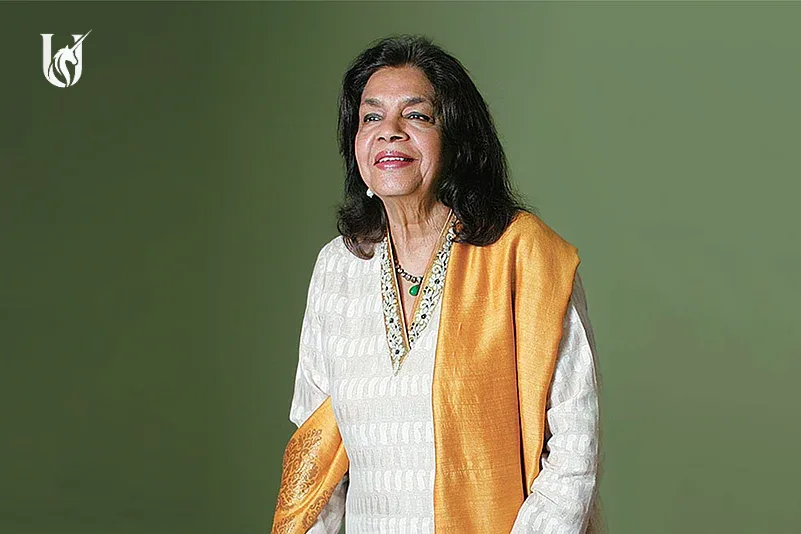
Meena Bindra did not enter business with dreams of building a fashion empire.
In the late 1980s, as her children grew older, she simply wanted to contribute some extra income to her family.
A conventional job did not seem practical, so she turned to something she already understood—clothes and design.
With an Rs 8,000 bank loan, she began making and selling salwar suits from home.
That modest experiment would eventually become BIBA, a recognised name in Indian ethnic fashion.
Her story began not with ambition for scale, but with the courage to start small.
Meena Bindra’s Early Life & The Confidence to Begin
Before becoming an entrepreneur, Bindra was a homemaker, mother and graduate who had moved across cities with her husband, a government employee.
She had always enjoyed stitching and experimenting with clothing designs, but had never treated it as a formal career.
A few small exhibitions gave her an important signal, the designs she created were attracting customers.
Instead of waiting for the perfect opportunity, she decided to test her idea commercially.
She bought fabric, arranged stitching and personally handled customers and sales.
Every early transaction slowly transformed a hobby into a serious business.
The Idea Behind BIBA: Making Ethnic Wear Easier
Bindra noticed a simple gap in the women's fashion market: Indian women wanted traditional clothing that was comfortable, practical and affordable.
Salwar-kameez offered exactly that combination, particularly for women looking for an everyday alternative to sarees.
BIBA focused on colourful printed cotton suits that could be worn comfortably without losing their ethnic identity.
In the early years, some suits were priced around Rs 190, making them accessible to a broad consumer base.
The brand gradually developed a distinctive proposition around everyday Indian fashion with a modern touch.
That understanding of the customer became one of BIBA's strongest competitive advantages.
From One Woman’s Home to a Growing Business
In the beginning, Meena Bindra was the designer, buyer, seller and problem-solver all at once.
She had to source fabrics, develop designs, coordinate production, manage customers and keep the household running simultaneously.
There were no large teams or institutional investors behind her, only limited capital and a growing belief in the product.
Her philosophy remained simple: understand what customers want, price it sensibly and make the business profitable.
As demand increased, the operation gradually moved beyond her home-based setup.
What started as a personal income project began developing the foundations of a scalable fashion company.
The Retail Revolution That Changed BIBA
The emergence of organised retail in India opened a major new chapter for BIBA.
Retailers such as Shoppers Stop began showing interest in the brand, pushing Bindra to rethink how she produced and planned collections.
Instead of making clothes whenever required, BIBA had to prepare complete seasonal collections months in advance.
The company began supplying major chains including Shoppers Stop, Lifestyle and Pantaloons.
Wholesale became an important growth engine and introduced BIBA to customers across a much wider geography.
It was the moment when a home-grown label began becoming an organised fashion brand.
The Bold Decision to Build BIBA’s Own Stores
For years, BIBA depended heavily on other retailers to reach customers, but the founders eventually saw a larger opportunity.
In 2004, the company entered its own retail business and opened its first two stores in Mumbai.
The timing worked in its favour as shopping malls and organised retail were rapidly expanding across Indian cities.
Owning stores meant BIBA could control its presentation, customer experience and relationship with shoppers.
The company gradually expanded from major metros into markets such as Surat, Kanpur, Jaipur and Ahmedabad.
BIBA was no longer simply supplying fashion, it was building a consumer brand of its own.
Institutional Capital & The Next Stage of Growth
BIBA's growing scale eventually attracted serious institutional interest, including investment from Future Group.
In December 2013, Warburg Pincus and Faering Capital invested Rs 300 crore in the company.
The funding provided more than capital; it demonstrated that Indian ethnic wear could become a large organised fashion opportunity.
The company used its growing platform to expand its retail presence and strengthen its product portfolio.
Over time, BIBA moved beyond traditional salwar suits into fusion wear, wedding collections, accessories, footwear and other categories.
The brand continued evolving while retaining its core connection with Indian women and ethnic fashion.
Building a Brand Beyond India
BIBA's ambition eventually moved beyond the Indian market as the company explored international demand for Indian fashion.
Its products expanded into markets including the UAE, Singapore, the UK, the US, Canada, Bangladesh and Nepal.
The company also developed specialised offerings such as BIBA Girls to reach younger consumers.
Its presence across physical stores and major multi-brand retail chains helped establish a wider distribution network.
With hundreds of outlets and a significant multi-brand presence, BIBA grew far beyond its original home-based roots.
The larger vision became clear: take contemporary Indian fashion to customers wherever there was demand for it.
BIBA, Bollywood & Creating Cultural Visibility
BIBA also experimented with a marketing route that was relatively uncommon for Indian fashion brands at the time, Bollywood merchandising.
The brand's creations appeared in films including Na Tum Jano Na Hum, Hulchul and Baghban.
Seeing BIBA's designs on the big screen gave the brand a new form of cultural visibility.
The company also entered premium designer collaborations, including a luxury pet line with designers Rohit Bal and Anju Modi.
Rather than relying heavily on celebrity-driven promotion, Bindra believed that a strong product and memorable shopping experience could speak for themselves.
That quiet confidence became an important part of the BIBA story.
Challenges Behind the Success
BIBA's growth was never effortless, particularly during its early years of limited resources and small-scale production.
As the company began supplying large retailers, maintaining consistent quality and meeting demanding supply schedules became increasingly complex.
Expansion also meant managing inventory, production, competition and changing customer preferences at a much larger scale.
The COVID-19 pandemic created another major disruption for the fashion and retail industry.
BIBA eventually recovered, but recent financial performance shows that scale does not automatically guarantee profitability.
Its journey demonstrates that even established brands must continuously adapt to changing market realities.
BIBA’s Financial Journey
According to Tracxn data cited in the supplied information, BIBA's revenue increased from Rs 569.18 crore in FY21 to Rs 663.25 crore in FY22.
Revenue then climbed sharply to Rs 890.28 crore in FY23 before declining to Rs 768.50 crore in FY24.
In FY25, revenue recovered to approximately Rs 798.12 crore, showing renewed momentum after the earlier decline.
The company reported a profit of Rs 52.97 crore in FY23 but moved into losses in FY24 and FY25.
Its loss stood at Rs 94.91 crore in FY24 and narrowed to Rs 82.87 crore in FY25.
These numbers underline an important lesson: building a large fashion brand requires constant attention to both growth and financial discipline.
Meena Bindra’s Legacy
Meena Bindra's greatest achievement may not simply be the number of BIBA stores or the scale of its operations.
It is the fact that she entered entrepreneurship at a stage when women starting businesses was still considered unusual.
She began with an ₹8,000 loan and no formal fashion-business background, yet built a brand that reached generations of Indian consumers.
Her sons later became part of the company's larger journey, helping transform a home enterprise into an organised fashion business.
BIBA's evolution reflects how one woman's understanding of everyday Indian women could become a nationwide fashion movement.
Her journey remains a powerful example of what can happen when experience, instinct and persistence come together.
Meena Bindra’s Net Worth & BIBA Valuation
Meena Bindra's personal net worth and BIBA's current valuation are not reliably established in the supplied information, so a definitive figure would be misleading.
What is clearly documented is the scale BIBA has achieved, with substantial revenues, a large retail footprint and international operations.
The ₹300 crore investment by Warburg Pincus and Faering Capital in 2013 remains a significant milestone in the company's corporate journey.
Rather than focusing only on a headline valuation, BIBA's long-term brand equity is reflected in its enduring consumer presence.
The company has survived shifts from traditional retail to malls, e-commerce and changing fashion preferences.
That longevity itself is one of the strongest measures of the value Meena Bindra created.
What Entrepreneurs Can Learn From Meena Bindra
Meena Bindra's story proves that entrepreneurship does not always begin with a revolutionary idea, it can begin with a practical problem.
She started small, listened carefully to customers and built around what Indian women actually wanted to wear.
She did not wait for formal business training, large funding or a perfect moment before taking the first step.
Her willingness to evolve from home production to wholesale and eventually branded retail allowed BIBA to scale with the market.
Most importantly, she stayed focused on product quality and customer relevance rather than chasing unnecessary attention.
Her journey carries one timeless message: you do not need to start big to build something that lasts.